Wednesday, 28 March 2012

Brafton: Social marketing alert: Brand engagement increases with Facebook Timeline

Brafton
News Content Marketing
Social marketing alert: Brand engagement increases with Facebook Timeline
Mar 28th 2012, 15:09

Facebook recently reported that brand engagement has increased since the network launched Timeline.

A report from Simply Measured found that Facebook's launch of Timeline for brand pages has resulted in increased engagement for businesses. The update places a greater emphasis on visual content, and Facebook rolled out the platform with the idea that this feature would allow companies to transform social media marketing into storytelling.

According to Simply Measured, brands have seen engagement per post increase by 46 percent since Timeline rolled out in late February. The page layout organizes content so that users can follow it chronologically with a focus on visuals posted to brand pages.

Additionally, 14 percent more Facebook users are engaging with brand pages since Timeline went live. They are acting on content 46 percent more frequently in terms of Liking posts and commenting. The nature of Timeline has improved the viewer's focus photos and video to the tune of 65 percent more engagement.

Simply Measured studied 15 brands for its report and just three of them have seen less engagement since Timeline rolled out.

The study also found that links, photos and video content have become more popular for fans since Timeline became available. The only social content to see less engagement in recent weeks is the status update, and this was expected given Timeline's highly visual focus.

In light of the increased emphasis on video content with Timeline, it's likely that more companies will begin including it as part of their social strategy. Brafton recently reported that more than 180 million Americans watched video content online in February. 

Media files:
facebook-login-page-e1325627547588-300x75.jpg (image/jpeg, 0 MB)
You are receiving this email because you subscribed to this feed at blogtrottr.com.

If you no longer wish to receive these emails, you can unsubscribe from this feed, or manage all your subscriptions

Brafton: Siri increases search and email use from iPhone users

Brafton
News Content Marketing
Siri increases search and email use from iPhone users
Mar 28th 2012, 13:47

Siri has led to increased use of mobile search and email access, which can help marketers.

A study from the Wall Street Journal found that users of the iPhone 4S are growing increasingly fond of Siri, the voice-activated assistant that comes standard with the device. The results should be good news for internet marketers hoping to reach more mobile audiences via search and email marketing. They show that Siri users are searching the web from their handsets more frequently, while they also access their email more often since they can send messages much easier.

According to the Wall Street Journal, one-third of iPhone 4S users search the web with their handsets using Siri.

For marketers, increased use of Siri places a focus on creating website content more likely to appeal to mobile search algorithms. Siri is among the most advanced voice recognition software available to consumers at the moment, and new media marketing plans of all kinds stand to benefit.

The ultimate effects on the way content marketing campaigns are launched will likely be minimal. However, the local element of mobile search algorithms means that articles and blogs used for marketing should include geo-centric keywords to appeal to Siri users looking for nearby businesses. Essentially, local optimization best practices can help brands reach these consumers.

A mobile search presence is critical for businesses, as smartphone users prefer accessing website content on their handsets from search as opposed to using mobile apps, Brafton recently reported. Many said they enjoy seeing content from several different websites when researching a purchase on their phones, motivating them to use the mobile web.

You are receiving this email because you subscribed to this feed at blogtrottr.com.

If you no longer wish to receive these emails, you can unsubscribe from this feed, or manage all your subscriptions

Artikel Terkini Perniagaan Internet - SmartUsaha.com: Rujukan Usahawan: Organisasi Terlibat

Artikel Terkini Perniagaan Internet - SmartUsaha.com
Artikel terkini di blog SmartUsaha.com.
Rujukan Usahawan: Organisasi Terlibat
Mar 28th 2012, 12:26

Berikut adalah senarai organisasi yang mempunyai peranan masing-masing dalam memenuhi keperluan para usahawan dan perniagaan.

  1. SSM (Suruhanjaya Syarikat Malaysia). Perkhidmatan pendaftaran perniagaan dan syarikat. - www.ssm.com.my
  2. LHDN (Lembaga Hasil Dalam Negeri). Mengurus hal ehwal cukai perniagaan. - www.hasil.gov.my
  3. PERKESO (Pertubuhan Keselamatan Sosial) - www.perkeso.gov.my
  4. KWSP (Kumpulan Wang Simpanan Pekerja) - www.kwsp.gov.my
  5. PPZ (Pusat Pungutan Zakat) - www.zakat.com.my
  6. SME Corp. (Small and Medium Enterprise Corporation Malaysia). Dahulunya dikenali sebagai SMIDEC, dan kemudian ditukar kepada SME Corp., iaitu menjadi pusat maklumat setempat untuk perniagaan dan usahawan Malaysia. - www.smecorp.gov.my
  7. DPMM Pusat (Dewan Perniagaan Melayu Malaysia) - www.malaychamber.com
  8. PUIM (Persatuan Usahawan Internet Malaysia). Satu-satunya persatuan yang aktif menganjurkan aktiviti berkaitan perniagaan online, serta saluran hal ehwal bidang perniagaan internet di Malaysia. - www.puim.my
  9. PUNB (Perbadanan Usahawan Nasional Berhad). Menyediakan aktiviti seperti kursus, seminar dan peluang pinjaman kepada usahawan dan perniagaan. - www.punb.com.my
  10. MARA (Majlis Amanah Rakyat) - www.mara.gov.my
  11. SKM (Suruhanjaya Koperasi Malaysia) - www.skm.gov.my
  12. INSKEN (Institut Keusahawanan Negara) – www.insken.gov.my
  13. Portal Rakyat Malaysia - www.malaysia.gov.my (Untuk pendaftaran perniagaan SSM secara Online, perlu melalui portal ini).
  14. TERAJU (Peneraju Bumiputera) – www.teraju.gov.my
  15. MKM (Maktab Koperasi Malaysia) - www.mkm.edu.my
  16. PNS (Perbadanan Nasional Berhad). Untuk bisnes francais. - www.pns.com.my
  17. MyIPO (Intellectual Property Corporation of Malaysia / Perbadanan Harta Intelek Malaysia) - www.myipo.gov.my
  18. KPDNKK (Kementerian Perdagangan Dalam Negeri, Koperasi dan Kepenggunaan) - www.kpdnkk.gov.my
  19. MDeC (Multimedia Development Corporation) - www.mdec.my
  20. SKMM (Suruhanjaya Komunikasi dan Multimedia Malaysia) - www.skmm.gov.my
  21. MIDF (Malaysian Industrial Development Finance Berhad) - www.midf.com.my
  22. MATRADE (Malaysia External Trade Development Corporation / Perbadanan Pembangunan Perdagangan Luar Malaysia). Untuk perniagaan eksport produk ke luar negara. - www.matrade.gov.my
  23. The RIGHTS. Ini adalah sebuah syarikat awam. Mereka banyak menganjurkan aktiviti dan program keusahawanan. – www.rights.com.my
  24. MPC (Malaysia Productivity Corporation) - www.mpc.gov.my
  25. SME-INFO. Pusat maklumat setempat mengenai perniagaan kecil dan sederhana. - www.smeinfo.com.my
  26. Halal Malaysia – Permohonan sijil halal. - www.halal.gov.my
Banyak juga organisasi yang memainkan peranan masing-masing. Semoga senarai di atas memberi kemudahan untuk para usahawan membuat pilihan pihak yang terlibat.

*Akan dikemas kini dari semasa ke semasa. Cadangkan yang lain-lain di bahagian komen.

You are receiving this email because you subscribed to this feed at blogtrottr.com.

If you no longer wish to receive these emails, you can unsubscribe from this feed, or manage all your subscriptions

Tuesday, 27 March 2012

Brafton: Yahoo to discontinue Yahoo Meme, its little-known social network

Brafton
News Content Marketing
Yahoo to discontinue Yahoo Meme, its little-known social network
Mar 27th 2012, 17:19

Yahoo discontinued its Meme microblogging service, which was initially launched in 2009.

In 2009, Yahoo launched Meme, a microblogging service most comparable to Twitter. Unlike Twitter, it is probably not part of many brands social media marketing mix. In the three years since going live, Meme has garnered little traffic while other social networks have blossomed. As such, the company announced recently that it will discontinue the service, effective as of May 25, 2012.

Recent years have been difficult for Yahoo in terms of its web services. While Meme is the latest victim, Yahoo has seen decreases in its search volume compared to Google and Bing. Despite a partnership with Bing in search and ad management, Yahoo has dropped to become the No. 3 search engine in the U.S. and Brafton recently reported it loses market share by the month.

There are no figures available regarding Meme's current user base, however, it's likely that the figure has fallen to such a degree that Yahoo has opted to take this action.

For marketers, Meme's demise means little since it was never a major player that warranted attention. Perhaps, more than anything, discontinuing the website demonstrates the massive success of Facebook and Twitter, as the companies have started from scratch to become globally known and used organizations, where Yahoo was unable to leverage its established brand to drive success for Meme.

Other social networks from major global brands have failed in recent years, including Google Wave. Brafton reported in 2010 that Google Wave struggled to convince users to share content on the website, despite interest from marketers to leverage Google's contextual advertising capability. With recent reports that Google+ users stay on the network for just 3 minutes, many are still waiting to see if Google's latest social network will go the way of Yahoo Meme and Google Wave. 

You are receiving this email because you subscribed to this feed at blogtrottr.com.

If you no longer wish to receive these emails, you can unsubscribe from this feed, or manage all your subscriptions

Brafton: Multitasking consumers spend up 11 hours per day consuming content: Integrated marketing a must

Brafton
News Content Marketing
Multitasking consumers spend up 11 hours per day consuming content: Integrated marketing a must
Mar 27th 2012, 16:49

Consumers are increasingly multitasking in terms of media consumption.

A report from eMarketer found that Americans are becoming multitaskers in terms of the media they interact with on a daily basis. Increasingly, internet users are also watching television and using their smartphones or tablets while using other media, which means internet marketers have ample opportunities to reach their online audiences with integrated marketing campaigns.

The most frequent media consumption combination is watching television while using a mobile computing device, such as a smartphone, laptop or tablet computer. Beyond that, many respondents said they keep their television on while reading a newspaper, magazine or book. When combining content consumption across different devices, eMarketer estimates that consumers spend 11 hours per day on reading or viewing content.

For marketers, this increases the value of integrated new media marketing campaigns, since the average time spent on the web has reached about two hours and 47 minutes per day for each user (not counting the daily hour spent with mobile media, which may overlap with time online). Additionally, the average person still watches more than 4 four hours of television or videos every day, and the survey didn't distinguish between watching videos online or on TVs.

EMarketer spoke with other industry experts in its report and found that much of this media multitasking is complementary. For example, users will research a topic they see on television on the web with whichever device they have at hand.

"When people sit down to watch a TV show, and they have their iPad with them, they're not necessarily multitasking in contradictory ways," Edward Boches, creative director at ad agency Mullin, told eMarketer. "I may be watching something … and I'll just quickly Google something [to augment the experience]."

Integrated marketing efforts can help brands reach consumers on their content platforms of choice, and monitoring audience behaviors can inform web campaigns. As marketers identify engagement patterns, from the times of day consumers are finding a website through search or increased activity around relevant keywords updating strategies for maximum return is becoming more common. Brafton recently reported that branding campaigns on the web are typically adjusted 11 times as new prospect data becomes available.

Media files:
Businesswoman-using-electronic-tablet-334x75.jpg (image/jpeg, 0 MB)
You are receiving this email because you subscribed to this feed at blogtrottr.com.

If you no longer wish to receive these emails, you can unsubscribe from this feed, or manage all your subscriptions

Brafton: Consumers ‘much more likely to trust’ businesses with social presences

Brafton
News Content Marketing
Consumers 'much more likely to trust' businesses with social presences
Mar 27th 2012, 15:15

Executives who maintain social media accounts and post about their industry often improve the appeal of their business.

A report from BRANDfog found that prospects are more trusting of businesses when CEOs and other executives are active on social networks. According to the study, the transparency accessibility and - in many cases - expertise conveyed by executives who discuss their industries on social networks led to improved perceptions. Brands might take this as their cue to develop social marketing strategies for corporate and employee accounts.

Fifty-one percent of respondents said they are more likely to trust businesses with active social presences, while 31 percent are "much more likely," BRANDfog said. Just 18 percent reported that it had a negative impact or no effect on their perception of a company.

Aside from the transparency associated with the channel, businesses have also found that social media marketing is a valuable tool for improving sales and lead generation. Furthering this effort with insight provided by executives can only help a company boost brand recognition.

In terms of the companies using social, 86 percent said their CEO's social presence was important for the success of their campaign.

Active use of social media marketing is important for the success of other new media marketing campaigns. Brafton recently reported that using Twitter, Facebook and other platforms can boost the value of content marketing initiatives as the platforms can drive traffic and engagement.

You are receiving this email because you subscribed to this feed at blogtrottr.com.

If you no longer wish to receive these emails, you can unsubscribe from this feed, or manage all your subscriptions

Brafton: An inside look from Google: How you can use Google Analytics Social Reports to boost your bottom line

Brafton
News Content Marketing
An inside look from Google: How you can use Google Analytics Social Reports to boost your bottom line
Mar 27th 2012, 13:48

Social Value

Social media marketing may be a mainstream practice, but only 23 percent of businesses with social campaigns in place are satisfied with their social measurements. At last week's SES New York, insiders from the Google Analytics team shared insights with attendees on how the new social marketing metrics can help them understand the bottom-line benefits of their social strategies and invest in social content accordingly.

To start, Google reminded marketers that "social for social's sake" is not a valid reason to pour money into the channel. While social media is a competitive must, marketers need to invest strategically according to which channels and shared content drives the best results for them. As Avinash Kaushik, Google's digital marketing evangelist, said in his keynote, social marketing can't be "faith-based." The channel has to prove its economic value to brands. 

Investment in social marketing can't be faith based. It must be rooted in economic value.

Of course, there are some common problems encountered when marketers try to determine the impact of social media return on investment. Phil Mui, group product manager at Google Analytics, identified three major challenges associated with measuring social media:

1. Social often has an upper-funnel impact, and upper-funnel impact is always trickier to measure.

2. Social data silos are hard to aggregate and compare. Marketers presumably have campaigns in place for Facebook , Google+, Twitter and more. Each of these platforms counts as a silo, but then there is also the matter of breaking down social audiences according to age, gender, regions, etc. per platform and across platforms.

3. Off-site engagement is hard to identify and measure.

Mui offered insights on four key goals social marketers should be aiming toward - and four solutions offered by the new Google Analytics social reports that can help businesses boost their bottom lines.

1. FIND THE RELEVANT CONVERSATIONS WITH OFF-SITE ACTIVITY

"What are the relevant conversations happening in social?" Mui urged marketers to ask themselves. 

SES New York 2012 Google Analytics Ripples

Ilya Grigorik, software engineering manager at Google Analytics, was also present at the SES panel, and he offered attendees an inside look at how the soon-to-be rolled out social metrics features handle off-site activity reports. At present, high-level off-site data is only available for Google+ interactions.

Under the Activities Stream, marketers can monitor Events or Conversations. Events will show when a +1 happens, and the Conversations tab will open Google's Ripple visualization. This serves as an interactive graphic of the shares for a brand's website content (and/or content shared exclusively on Google+) on Google's social network. The data allows businesses to quickly identify their top content as well as find the key industry players who engage them on the web.

Using this information, marketers can get a sense of which custom content is the most successful on Google's network and share more of the same. They can also try understand the context of shares to discern where ongoing content marketing campaigns can answer users' questions. Moreover, insights on who is frequently sharing brand content will help marketers ensure they reach the right social audiences and highlight opportunities to develop brand advocates.

Again, Mui was quick to clarify that Ripple visualization is only available for Google+ information as the company doesn't have access to this type of data for other social networks. 

2. IDENTIFY THE SOCIAL REFERRALS (OR VISITS) THAT ARE RELEVANT TO YOUR BUSINESS WITH SOCIAL SOURCES

Marketers already have insights on their refferal traffic courtesy of the "Referrals" tab under "Traffic Sources" in Google Analytics. But at SES New York 2012, Google previewed the up-and-coming "Social" tab under "Traffic Sources." This tab will offer a more intuitive breakdown of the social traffic entering a site according to platforms. Marketers who have set up goals in Google Analytics (which anyone hoping to garner web conversions who uses Google Analytics should do) will also have the chance to break down their social traffic according to which sources are part of reverse goal funnels. They'll also have the ability to compare visits from social referrals to all visits to understand the level of site interaction that comes with social audiences.

By understanding which social sources drive the most website traffic, marketers can get some sense of where to devote their social marketing resources. Of course, there is a big difference between high quantities of traffic and high-quality traffic, and the nuanced social source breakdowns provided in Google Analytics will help marketers understand which sources provide engaged traffic. And this brings us to Miu's next point.

3. FIND THE WEBSITE CONTENT THAT DRIVES SOCIAL AUDIENCE INTERACTION VIA SOCIAL VISITORS REPORTS

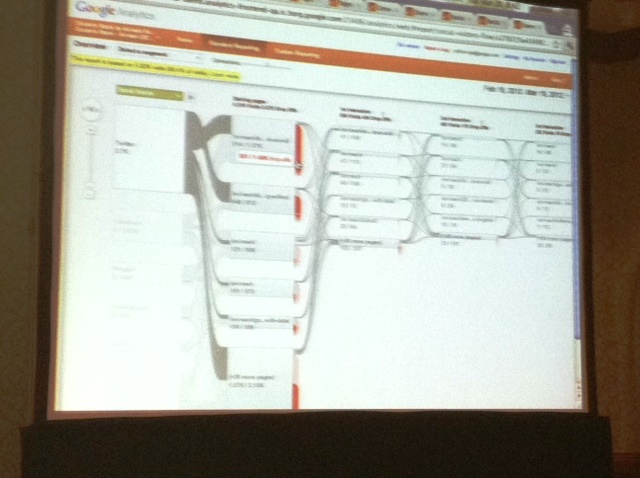
Once social users are led to a business' website, it's important to understand how they are engaging the site. Google Analytics' social metrics reporting includes Social Visitors Reports that make it easy to see where various social audiences are interacting on the site. SES New York Google Analytics visualizationMarketers can select a social source to follow visitors' paths across various blog posts, news articles or landing pages on a site. Alternatively, they can click on a content page to get a breakdown of which social sources drove the most traffic to that page and where visitors went next. Marketers can explore the popular pages and try to replicate what made them successful in ongoing content marketing initiatives.

In addition to showcasing the pages popular among social visitors, these funnel reports offer key insights on abandonment points. This data should call attention to pages that need to be revamped - either with more engaging information or better calls to action. (Check out other SES experts' insights on landing page optimization for related tips.)

4. RECOGNIZE HOW SOCIAL ACTIVITY IS TRANSLATING INTO DESIRABLE TRANSACTIONS WITH CONVERSIONS AND 'ASSISTED CONVERSIONS'

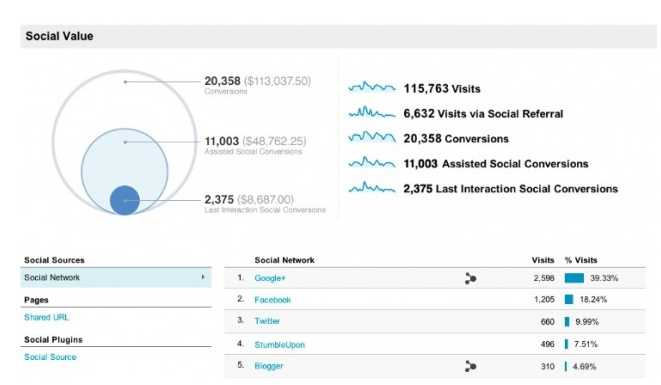
The Analytics feature that marketers might be most excited about is the new "Assisted Conversions" toolf. Although social is often a top-of-funnel tool, Assisted Conversions attempts to help marketers get at the economic value of their social marketing campaigns. As depicted in the graph below, the dark blue circle represents visits from social sources that resulted in conversions. The surrounding pale blue area represents traffic that arrived from a social source in the past month and subsequently converted. As Grigorik explained, the pale blue circle attempts to show where exposure to a business' social campaign has impacted conversions.

Social Assists

The intention of this feature is to show marketers when their social efforts are (or are not) boosting their bottom line.  

While Google hopes these insights will be helpful, Mui explained, "Google is not trying to tell marketers what model to use - it's up to individual businesses to decide how they want to recognize data for their companies."

The social metrics reports should be rolled out to all Analytics users within the next couple of weeks.

Media files:
Social-Value-323x75.png (image/png, 0 MB)
You are receiving this email because you subscribed to this feed at blogtrottr.com.

If you no longer wish to receive these emails, you can unsubscribe from this feed, or manage all your subscriptions