Friday, 13 September 2013

Brafton: SEO update: Google gives more backlink data

Brafton
News Content Marketing 
300+% Conversion Increase

Learn how startups and leading businesses alike are getting huge results using web personalization and behavioral targeting the easy way in this ebook. Get it now!
From our sponsors
SEO update: Google gives more backlink data
Sep 13th 2013, 13:30, by Lauren Kaye

Google will now provide webmasters with more backlink data to advise their SEO strategies.

At SES San Francisco, Google alluded to a new Webmaster Tool that would finally provide webmasters with the backlink data they've been craving. An announcement on the official Webmaster Central Blog post confirms it - marketers will soon be able to download backlink data that provides a more accurate swath of the sources referencing their brand content.

When webmasters hit the "Download more sample links" button in the past, Google gave them around 100,000 backlinks. However, the search engine chose cross sections lexicographically, which meant some sites did not receive examples that represented the entire gamut of links. Rather, they received a larger portion with domains names that fell in the first half of the alphabet.

Although the examples will still be ordered alphabetically, the results will give a more panoramic view of the websites recommending their online content. Additionally, the new reports will show examples from different domain names and top-level domains (TLDs).

Google's Search Engineer Matt Cutts has been hinting at a move toward more transparent backlink reporting in recent Webmaster Help Channel videos. Brafton previously reported that the search engine has started offering more examples for manual webspam actions in its reports as well.

Detailed reports that offer transparent insight might be the key to recovering from Google's Penguin algorithm. A Search Engine Round Table study found that half of webmasters say they've been hit by the spam-fighting technology, but only 7 percent think they've fully bounced back.

Media files:
backlink-data.jpg (image/jpeg, 0.3 MB)
You are receiving this email because you subscribed to this feed at blogtrottr.com.

If you no longer wish to receive these emails, you can unsubscribe from this feed, or manage all your subscriptions

Thursday, 12 September 2013

Brafton: ​Google as editorial arbiter: Cutts on SEO content standards #SESSF

Brafton
News Content Marketing 
Learn from successful entrepreneurs.

Pick up tips and advice from the noteworthy when you subscribe to Startup Frontier! Read interviews on how they launched and built their businesses.
From our sponsors
​Google as editorial arbiter: Cutts on SEO content standards #SESSF
Sep 12th 2013, 19:53, by Katherine Griwert

Matt Cutts at SESSF

Matt Cutts opened day two of SES San Francisco, detailing a Google quality process that's familiar to content marketers (and all website owners) concerned with SEO. "Google rolls out 500 new algorithms every year, and we spend hour-long meetings deciding what's appropriate and what's not."

Any brand site that's ever lost (or gained) traffic through Penguin or Panda is familiar with the concept of Google as an arbiter of editorial quality. "Every search engine has an editorial voice," said Cutts. For website owners, this means published content has to meet Google's quality standards to rank in SERPs, although Google stands by the fact that the best thing you can do to meet its SEO and editorial standards is to create content for users. He and Patrick Thomas of the User Policy team shared insights on "tough-call" manual penalties – and offered some insights on how their editorial/UX ideals might influence future algorithms.

Blurred lines for manual penalties

"Our search results and features should be comprehensive and we keep manual removals to a minimum," said Thomas. The company recently released a feature that clarifies manual penalties for webmasters. "We prefer algorithms over manual actions."

 "I would love to be replaced by a program." - a joking Matt Cutts 

Still, some situations that involve potentially hateful, violent or dangerous content puts Google in a position to make a call on removing offensive material. Auto-complete and instant search heighten the debate over Google's role in censoring content: For example, after the Boston bombing, auto-complete suggested pressure cooker bombs for users queries referencing the event. Google's team stepped in to debate whether that should be removed.

The issue of whether or not to manually remove (potentially) offensive pages comes up more than people might think, unless they work at a search engine. Cutts and Thomas offered a list of some of the commonly debated content areas, asking the audience to weigh in:

  • Viruses and malware [audience seemed to agree this should be censored]
  • Leaked personal ID info (ie: credit card numbers) [audience seemed to agree this should be censored]
  • Porn [audience seemed to agree this should be censored]
  • Violent images [audience mixed: Is there a potential value in understanding consequences of certain actions?]
  • Hate content [audience mixed: Is it valid for research purposes to assay hateful conversations?]
  • Hacking instructions [audience seemed to agree this should be censored]
  • Bomb-making instructions [audience seemed to agree this should be censored]
  • Pro-anorexia sites "teaching" people to develop the eating disorder [audience mixed: Is this a helpful research tool, especially for doctors and parents?]
  • Satanism and wiccanism [audience seemed to agree this should remain online]
  • Necrophilia [audience mixed: Is this valuable for research of a cultural phenomenon?]
  • Content farms [audience mixed: It's hard to make a call on whether a site is one, and Panda exists]
  • Blackhat SEO boards [audience mixed: Is this even helpful to see what spam tactics should be guarded against?]

Check out the video of Cutts and Thomas on this topic from last year's SMX.  Cutts and Thomas, conscious of Google's role in making content available, would prefer to have algorithms make the decisions. "I would love to be replaced by a program," Cutts joked.

He was also quick to point out that even if Google removes something from its index, it still exists on the web. "People make the mistake of thinking it only matters if [content]'s on Google but there are lots of ways people discover." This is a valid reminder for companies that are myopic in their web marketing strategies, focusing too heavily on Google rankings at the cost of social marketing, email and similar initiatives that aim to share great content and information with users.

Google's influence on content (and sites) by way of SEO standards

Even while Cutts asserted there are ways for questionable (and all) content to be discovered beyond Google, he suggested Google makes algorithm decisions that can impact the direction of digital media behavior. It's a "chicken-or-the-egg" effect on web content quality, and Cutts offered a couple of examples.

"I wouldn't be surprised if we soon take mobile page speed into account for SEO." - Matt Cutts

Panda: The search engine was making an effort to promote good content, and aware of Google's influence, Panda was a means to demand that content marketing efforts step it up.

Page speed: The company announced page speed as a ranking factor in order to give users access to fast-loading sites. The change also made site owners more conscious of site speed to encourage better practices.

What's next for "chicken-or-the-egg" SEO/ editorial standards?

Neither of the Google reps confirmed "SEO essentials" for the future, but here are two areas discussed:

Mobile site speed: "Mobile is probably growing faster than anyone in the room expects. Mobile traffic to Google will surpass desktop traffic to Google pretty soon – not in weeks or a few months... but soon," Cutts said.

He went on to hint, "I wouldn't be surprised if we soon take mobile page speed into account for SEO."

Authorship: Cutts also referenced Google's rising interest in authority. "[As a Google user,] I would want to be able to prioritize content from experts." He clarified: "I'm not saying Authorship will give users a direct ranking boost, but it certainly helps click-through rates."

Google's interest in getting businesses to use Authorship is clear: The feature has recently gotten a lot of air time from Google reps. In the past month, the company:

An overview of chronological Authorship developments and set up steps can be found in Brafton's latest guide book: Content Marketing, Meet Authorship.

Cutts and Thomas ended the session by reminding everyone of Google's most iterated adage: What's best for the user is best for SEO.

Check out more insights from Cutts on the future of SEO from SMX West in this related post.

Media files:
Matt-Cutts-at-SESSF.png (image/png, 0.4 MB)
You are receiving this email because you subscribed to this feed at blogtrottr.com.

If you no longer wish to receive these emails, you can unsubscribe from this feed, or manage all your subscriptions

Brafton: Panda problems? Improve your web content quality

Brafton
News Content Marketing 
Want to learn how to design a logo?

This beginner logo design course will take you step by step through the process from start to finish.
From our sponsors
Panda problems? Improve your web content quality
Sep 12th 2013, 15:58, by Lauren Kaye

Google now evaluates brands' web content for quality every time it indexes pages.

Marketers might have noticed their search rankings fluctuating as of late. This is a symptom of continual Panda updates, which are now part of Google's regular indexing process, according to Search Engineer Matt Cutts. In the latest Webmaster Help Channel video, Cutts offers SEOs advice for winning top SERP positions or recovering from downgrades if their sites were hit by the Panda algorithm. Create custom content that's useful, original and enjoyable to read, he says.

Panda targets poor-quality digital content, so brands' rankings might be affected if their pages contain information that's duplicated elsewhere on the site, scraped or combed from another source, Cutts explained.

Unhelpful content triggers Panda attack

However, waning SEO results might be owed to content creation flaws that are even more subtle. Panda also punishes domains if users find the information unhelpful or misleading. High bounce rates, low time on site and meager clickthrough rates are signs visitors don't find the information useful. If marketers see these types of numbers in their content analytics reports, they should consider ways to revamp their content-writing strategy with more engaging materials.

Panda also punishes domains if users find the information unhelpful or misleading.

It's crucial for brands to get on page 1 of Google SERPs to stay visible online. Handling nearly two-thirds of all queries performed by U.S. consumers, Google is the dominant search engine, and domains listed on the first page of results receive 95 percent of all clicks, Brafton previously reported. Marketers who fail to get their pages on Page 1 or 2 drastically reduce their brands' chances of generating leads and fueling conversions.

High-quality content now the standard

Perhaps more importantly, Cutts suggests that content quality will only become more important for search rankings.

"If you are not ranking as highly as you were in the past … it's always a good idea to think about, OK, can I look at the quality of the content on the site?"

"That would be the overriding goal and since Panda is now integrated with indexing, that remains the goal of our entire indexing system. So, if you are not ranking as highly as you were in the past … it's always a good idea to think about, OK, can I look at the quality of the content on the site?"

Corporate blogs and news articles must have a bigger purpose than plugging brands' products and services. If marketing collateral does not give readers innate value and provide them with a reason to return, it will eventually be edged out of search results by sites that offer better user experiences.

Media files:
Panda-algoritm-update.jpg (image/jpeg, 0.8 MB)
You are receiving this email because you subscribed to this feed at blogtrottr.com.

If you no longer wish to receive these emails, you can unsubscribe from this feed, or manage all your subscriptions

Brafton: Storytelling and audience targeting crucial for content ROI

Brafton
News Content Marketing 
Your small business full-time assistant

Join the 500,000+ people using Shoeboxed to streamline accounting and bookkeeping. Turn a pile of receipts into digital data to save time, money and hassle.
From our sponsors
Storytelling and audience targeting crucial for content ROI
Sep 12th 2013, 13:33, by Lauren Kaye

Brands must tell compelling stories to drive content ROI.

Most brands understand the basics of content marketing - fresh, timely content draws website traffic and generates leads. By sharing headlines and facts on social networks, marketers build brand awareness, and they further educate prospects with complementary visuals and long-form collateral. But what really separates the winners and losers in the world of internet marketing? Audience targeting and storytelling are the factors that divide campaigns performing at par and those driving impressive results, according to a survey of B2B Technology Marketing Community members on LinkedIn.

Around 71 percent of respondents said audience relevance is the most important element in content marketing campaigns. Engaging and compelling storytelling ranked second, with 56 percent citing this factor as fundamental for success on the web.

These figures imply that marketers have finally heard Google's messages loud and clear - content is king and top-notch quality is the only way to win. If they aren't creating materials with their audiences' in mind (and are instead trying to win-over search crawlers), marketers' web content will fall to the bottom of SERPs.

Just 15 percent of respondents listed SEO-driven writing as a crucial factor in measuring web marketing performance, suggesting that brands recognize the advantage of narrative over keyword stuffing.

Just 15 percent of respondents listed SEO-driven writing as a crucial factor in measuring web marketing performance.

The shift away from basic SEO practices and movement toward sophisticated content marketing efforts is also supported by brands' investments in new media formats. Video, for example, has been deemed one of the best vessels for delivering brand messages. It's also an effective way to tell stories. Brafton previously reported that a brand's ability to convey attention-grabbing information in a way that captivates readers is the secret to building huge audiences and generating leads.

As the landscape continues to develop, businesses will need to switch gears to guarantee that all of their content-creation efforts are generating information that's relevant to prospects and easy to follow.

Media files:
shutterstock_111103529.jpg (image/jpeg, 0.3 MB)
You are receiving this email because you subscribed to this feed at blogtrottr.com.

If you no longer wish to receive these emails, you can unsubscribe from this feed, or manage all your subscriptions

Artikel Terkini Perniagaan Internet - SmartUsaha.com: 5 Model Perniagaan Internet

Artikel Terkini Perniagaan Internet - SmartUsaha.com
Artikel terkini di blog SmartUsaha.com. 
Earn an MBA degree

Advance your career with an MBA Only $325 per credit hour
From our sponsors
5 Model Perniagaan Internet
Sep 12th 2013, 12:06, by smartzul

Selain menjual produk fizikal, banyak lagi jenis dan bentuk perniagaan lain yang boleh dilakukan secara online. Berdasarkan pengalaman saya mengendalikan usahawan Internet baru, kebanyakan mereka hanya mengarahkan pemikiran mereka terhadap produk fizikal semata-mata. Antara model bisnes Internet selain model bisnes produk fizikal adalah seperti: 1. Jadi orang tengah Pernah diceritakan oleh kenalan saya, seorang bukan […]

You are receiving this email because you subscribed to this feed at blogtrottr.com.

If you no longer wish to receive these emails, you can unsubscribe from this feed, or manage all your subscriptions

Wednesday, 11 September 2013

Brafton: How to win with video content – Insights from Brafton’s September #cmQs

Brafton
News Content Marketing 
Learn from successful entrepreneurs.

Pick up tips and advice from the noteworthy when you subscribe to Startup Frontier! Read interviews on how they launched and built their businesses.
From our sponsors
How to win with video content – Insights from Brafton's September #cmQs
Sep 11th 2013, 21:56, by Lauren Kaye

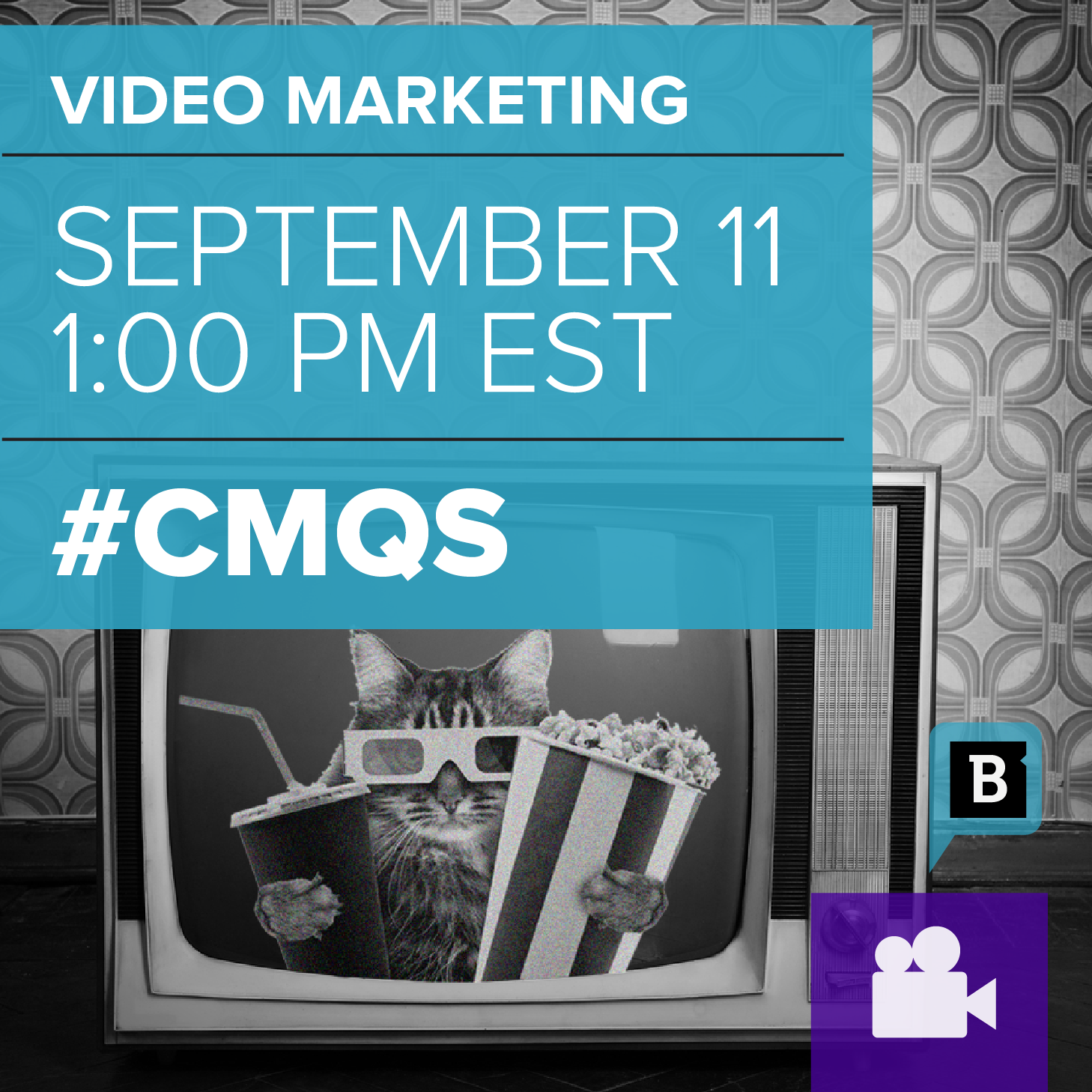
Brafton's Video Webinar #cmQs discuss video content.

Brafton held a live Twitter chat on September 11, 2013 to discuss one of today's fastest-rising trends in content marketing - video. Many brands face a common dilemma. They know they want video content, but they don't know exactly how to get there, or how streaming media fits into their current strategies.

Brafton hosted a conversation to share insights about what's most important when developing a successful video marketing campaign, from the equipment that's crucial for professional results to the best metrics for measuring performance.

Here are some highlights from the event, if you weren't able to tune in live:

Q1: Video - in-house or outsource: Pros and Cons? #cmQs

 Michael Bratschi's response to Brafton's latest #cmQs question.

Q2: What companies have #videos you find engaging AND effective? (Show us your brand videos!) #cmQs

Ross Brouse answers a question in Brafton's Twitter Chat.

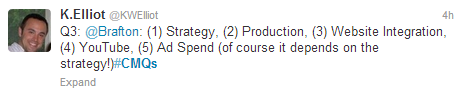
Q3: Rank the importance of each element of your videos: Strategy, production, website integration, ad spend, YouTube Channel? #cmQs

Kevin Elliot answers a question for Brafton's Twitter Chat.

Q4: How does #video play into your sales funnel? What are your biggest goals?#cmQs

Ted Karczewski answers a question for Brafton's Twitter Chat.

Q5: Where NOT to cut corners: What are the most important #video elements to get right for professional #branded #video? #cmQs

Ken Wong answers questions for Brafton's Twitter chat.

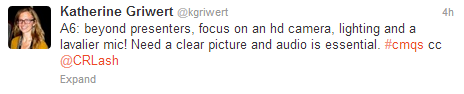
Bonus fan Q6: When upgrading from DIY to a professional in-office studio, what equipment do you recommend? #cmQs

Katherine Griwert answers questions in Brafton's Twitter chat.

Q7: #SEO is a common #video mktg goal. How do you optimize video site landing pages for search? #cmQs

Brad Leibowitz answers questions for Brafton's Twitter Chat.

Q8: How do you measure the #SEO impact of your #videos? #cmQs

Lauren Kaye answers questions for Brafton's Twitter Chat.

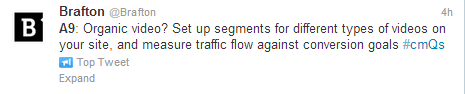
Q9: 72% of marketers 'believe' #video increases purchases. How do you measure the lead gen/ sales impact?

Brafton answers a question in the latest #cmQs.

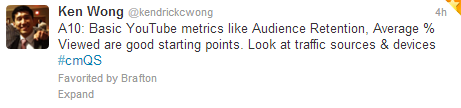
Q10: What #metrics can help you invest smarter in #video that delivers return? #cmQs

Ken Wong answers questions for Brafton's Twitter Chat.

Media files:
VideoWebinar_CMQ-01.png (image/png, 0.9 MB)
You are receiving this email because you subscribed to this feed at blogtrottr.com.

If you no longer wish to receive these emails, you can unsubscribe from this feed, or manage all your subscriptions

Brafton: Organic content unscathed by promoted Facebook Posts

Brafton
News Content Marketing 
Helpdesk Ticketing System

Award-winning helpdesk system with an inbuilt KBase, forums, canned responses & more. Try super user friendly Freshdesk today. (In 2 minutes, You'll set it up!)
From our sponsors
Organic content unscathed by promoted Facebook Posts
Sep 11th 2013, 15:32, by Lauren Kaye

Facebook promoted posts don't impact organic content's reach.

After Facebook allowed brands to sponsor posts on the social network, marketers might have worried that their organic social media content would get lost in the noise. However, organic content is still neck and neck with promoted posts for social media impressions without the added reach and visibility that sponsorship provides, according to a recently released WiseMetrics study. This proves that natural content is still one of the best ways to drive results and engage customers.

The number of organic impressions for promoted and un-promoted posts were roughly the same on a large scale. A purchased ad receives around 1,000 impressions for every 1,000 impressions an un-sponsored post earns.

Brafton previously reported that social media users are more open to promoted content than internet users performing search queries (44 percent said they think it's important that social media content be personalized). Therefore, brands may not alienate their prospects by pushing content on their newsfeeds, but it's wise to approach with caution.

A purchased ad receives around 1,000 impressions for every 1,000 impressions an un-sponsored post earns.

WiseMetrics data indicates that Facebook's algorithm does not punish brands for sharing spammy content on users' newsfeeds, but the social network recently updated its ranking signals. To remain at the surface of constantly churning social discussions, businesses must share information that's timely and relevant. Facebook says it will now filter out updates that do not receive clicks and engagement - a sign that users deem these posts valueless - as a way to improve its user experience.

Due to Facebook's algorithmic changes, marketers may find that brand content that previously hovered at the top of screens quickly falls to the bottom if it does not entertain, educate or offer viewers exclusive access to products and services.

Media files:
Facebook-promoted-posts.png (image/png, 0.3 MB)
You are receiving this email because you subscribed to this feed at blogtrottr.com.

If you no longer wish to receive these emails, you can unsubscribe from this feed, or manage all your subscriptions